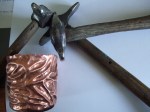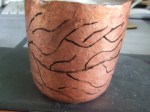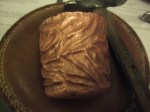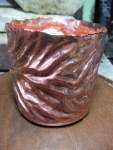
Doming or dapping punches used for chasing and repousse jewellery jewelery

Hello all and a very happy easter.

The clocks have gone forward today, I truly wish my dogs were aware as early dawn chorus was not welcome after a night out at a family birthday bash! Bless them eh. Oh to just want for nothing more than walkies and a full belly, I wish ; )

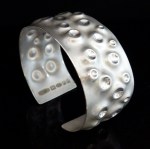
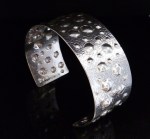
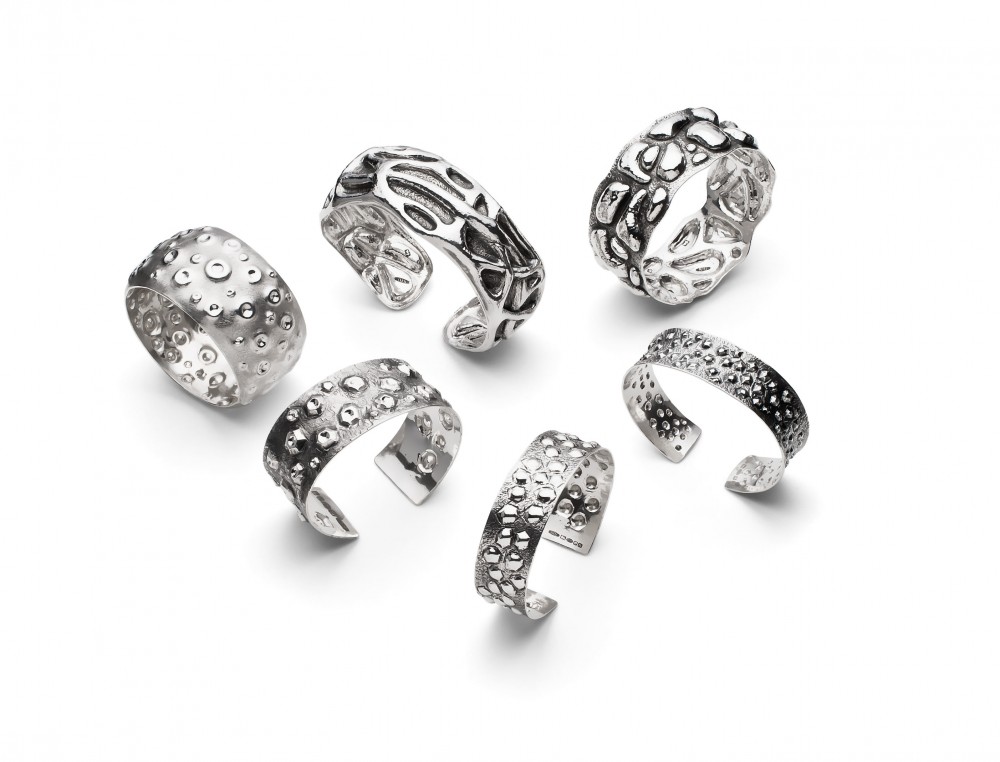
As promised, some examples of my jewellery work that use doming or dapping punches as a pivotal tool for creating the effects you see here. As I wrote before, I am a huge fan of them, I just felt bound to point out the challenges people may face who wish to use them for themselves in their own creations.

I guess technically the simpler jewelery designs shown here could reasonably be called stamping. I would like to give reasons why this is, in my opinion, not strictly true in these pieces.

If one uses a doming or dapping block the metal will conform to the ridged male and female parts, creating a perfect, reproducible and measurable copy of the tools used. If you look closely at the open c cuff with the matt finish, you will notice the sloping of the sides, creating a gentle ‘hill like’ ramp that leads up to, and compliments the turning in of the rim. This helps to lead the eye towards the centre polished interior of the domes, a bonus also is the very tactile nature of the risen elements with no sharp ridges. I know I have knocked back other versions by faceting, this was to take the design somewhere else after I had looked at the possibilities with this method. This is achieved by using pitch as a doming block. By altering the temperature, or using pitches with varying hardness, the pitch will support the metal more or less. By experimenting on practice scrap sheet, the viscosity, hardness can be arrived at to obtain the effect you wish to achieve.

A little insight as to how I arrived at this design. As a small child I was fascinated by microscopic images. Back when granny was a boy, yes that long ago, when I was small microscopes were rare and very expensive, unlike now. I remain fascinated with the hidden world we all are unable to see with the naked eye and still think of it often. For a College brief to formulate a design I turned to my old interest, coming up with heart on your sleeve, a cuff made from intertwined raised elements, I will show this another time.

The designs shown here were from me looking at red blood cells. I tried to use doming blocks, finding them too clumsy for cuffs, not suitable for domed surfaces and the domes were very pronounced, not that there is anything wrong with that, still looks fantastic, just did not fit the criteria I was looking for, also to satisfy the College tutors. I wanted the ‘blood-platelets’ to be more rounded at the edge and look as though they were growing out of the sheet rather than looking as though they were added elements that can perhaps be mistaken with a crisper punch and die approach.

The designs have morphed into the ones you see here, and a few more. I now call them the moon series or even stuck on you as they look a little like octopus tentacles. This is a great example of a design, once decided upon, becoming something else unforeseen and beautifully unpredictable. Another more practical consideration was from the reaction from some of my lady peers who were a little grossed out by the thought of blood cells. I have used this association with other designs that I will introduce in later posts.

In conclusion, to explain the techniques used. I first repoussed, from the inside the domes, then took the pieces off the pitch, turned it over face up and chased, using a smaller, or larger, doming punch to create the craters, depending upon the effect I wished to communicate.

The textures I used were created with punches and other techniques I will show next time.

I hope you all have a great holiday break.

Very best wishes.

Stu Art

Chasing and Repousse push punches

Hello again, in this post I will try to give a little more information for people wanting to start chasing and repousse in their jewellery or silversmithing work.

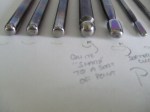
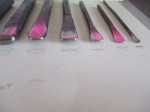
Pictured is a selection of the push tools I use. These tools are not exclusively used on the reverse, repousse stage, many are used to define the design from the front, chasing I’m sure you remember. I will not highlight the distinction again as I’m sure all will now be aware of the differences between chasing and repousse.

On the left you see the inclusion of a doming or dapping punch. I was advised that these make good starting out tools. I would advise caution if you choose to use different sizes to get you going as pitfalls await, fine if you want to achieve the results that they give, they remain a part of my tool kit, I will include pictures of items of jewelery I make using them to give examples.

I have marked in pencil the ‘sharpness’ of a doming punch. Obviously this is a relative term. To illustrate the point have a scrap piece of thin gage copper, silver if you are flash enough, and gently tap the punch into the piece whilst supported on pitch or felt, plaster scene. Use anything that will give a little, old telephone directories of thick leather will work also. As you try to control a straight line you will notice it wandering as the point of contact is small and being round it cannot find any purchase from previous blows, it being more likely to be deflected by the previous depression.

Another challenge this presents is the thinning of the metal at this, relatively, sharp point. This can cause problems later on if, like me, you are a little heavy handed it becomes more likely that successive blows it’ll perhaps lead to the punch breaking through. Also imagine the shape from the front. If you want to achieve a mountain like profile, then this is a good choice. Put your finger in the middle of some fabric and you may get what I’m trying to communicate.

The other tools all have gentler slopes that work more of the metal at each blow. Overlapping blows are easier to place as the tool is easier to guide by using part of the previous blows new shape as a guide for the next strike of the tool. Also straighter sides are easier to attain and thinning of the metal is kept to a minimum, the material being more moved than stretched to the centre of the high spot.

The tools on the right are used, by me, pretty much evenly on both sides. I think it fair to say that this process is very much a feel experience. With the help of having some test pieces of scrap you can envisage the shapes you wish to achieve. If my opinion was sought I would suggest that the newcomer spent much time experimenting with profiles on scrap pieces of metal to obtain their own ‘alphabet’ of shapes that can be combined to work towards making patterns that are in that persons head.

I found the learning curve very steep and demoralising. Being a stubborn old git I persisted, however I would like to stress that I have gone through a lot of blind alleys in my endeavours to communicate in this medium. Please notice I didn’t say mistakes as every one of these blind alleys helped me to create a better map for overcoming later obstacles.

For me the true beauty of this timeless way of working is the way you are forced to learn and discover all the time as your confidence grows and your ambitions for ever more effective ways to communicate overtake your current skill set.

Unlike many things today that we can tick off of our lists as been there got the T shirt and the certificate. Chasing and repousse, along with silversmithing and jewellery making are true lifelong journeys, never destinations.

Until next time then when I will show examples of work created with doming punches, this is to show that I am really a fan of them, not as it may be interoperated in this piece.

Very best wishes.

Stu Art

Hammer chased beaker example of air chasing with modified hammers

Hello, I had a thought that perhaps I could show an example of a lesser known chasing technique, hammer, or as it’s sometimes known as air chasing. If this style excites you as it does me then please check out the following master craftsman Hiroshi Suzuki.

http://www.thegoldsmiths.co.uk/exhibitions-promotions/who’s-who-in-gold-silver/designer-makers/hiroshi-suzuki/

Mr Suzuki appears not to have his own website, the Goldsmiths link above should give you a flavour, a Google search will keep you enthralled for hours. No, oh well just me then : )

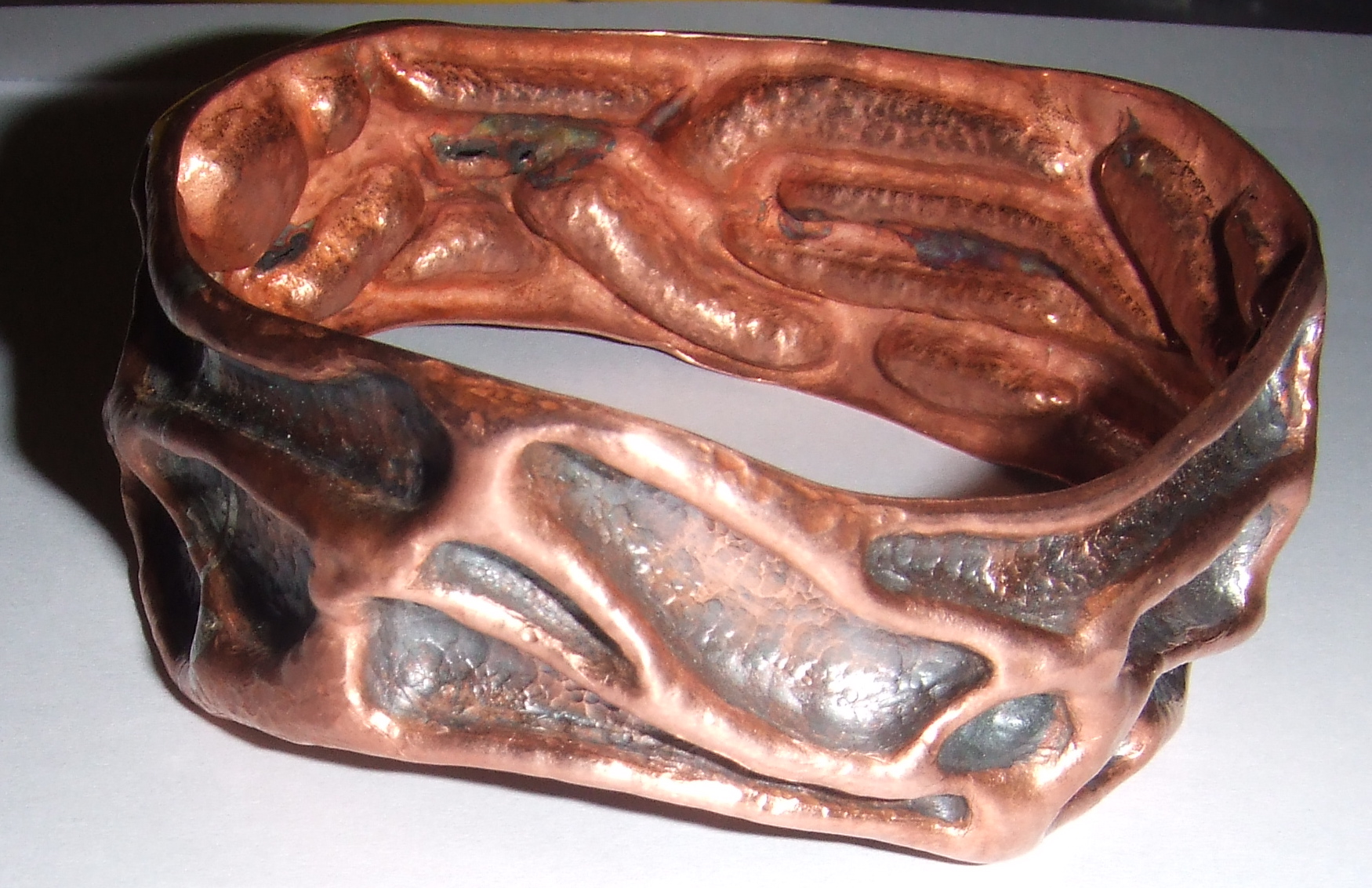
I approach all of my work by first making models, in copper mainly. I have found that recycling copper domestic hot water tanks is very cost effective and the material is plentiful making me more care free, spontaneous and less conscious of the cost implication of mistakes, oops sorry design opportunities. I will go into more depth as to the pros and cons of this approach in another post. As I have stated drawing is not a skill I possess sufficiently enough to communicate the three dimensional ideas I visualise so I make models and, for want of a better way of putting it, sculpt the design as I go along. I was self conscious about this until I discovered that Hiroshi Suzuki uses a similar approach. I would highly recommend you search out any literature that goes into depth about him as he has a very different and, to me, refreshing spontaneous approach that is remarkable when compared to the design design check and re check before you make approach that many of us take.

The hammers you see in the pictures were all modified from second hand ball peen and cross peen hammers, bought from a local market trader that specialises is house clearance. It is easy to be seduced by the artisans tools that, I’m sure you like me drool over in the tool catalogues. However perfectly serviceable and effective versions can be made with a little elbow grease and some imagination.

The results from this process are very effective and take far less time to achieve. The technique lends itself to more abstract designs giving a good opportunity to imply movement. I have not added texture to this piece as it is only a model and best left to use as a visual reference for me to return to. I will show others later with hammer and punch textures applied to show more.

To help give a personal, visual explanation of this approach I ask you to pinch the skin on the back of your hand with your thumb and forefinger. If you compare what you see with the raised sections of the design then you will have an idea of how it is achieved. First the broader faced hammers are used to create the valleys on either side of the lines drawn. Careful to alternate a little each side of the line to work towards the line. Then using the smaller, less broad hammer profiles you can refine the peaks to create the ridges. I have deliberately left these somewhat ‘soft’ if you will. If you look to some of the Suzuki examples you can see that it is possible to create a very accurate and defined sharp line if your design requires this. The danger with this technique, as I see it anyway, is that it is easy to get carried away with the rapid progress that the hammers make and annealing is neglected leading to a real danger of cracks and tears appearing in the overworked material. Keep this in mind, anneal often as you feel and hear the material, be it silver copper or whatever to keep this risk to a minimum.

Repairs are time consuming and a pain to do. I will show a repair in another post to show that all is not lost, even with the biggest mistakes, time and application of learned techniques can dig you out of most holes.

Silversmithing being a very expensive discipline to learn as the cost of the material becomes ever more expensive, makes silver-plating a direction that you may wish to consider. This would be a very attractive option for larger vessels of sculptural approaches using copper of gilding metal to create your work, sending it off for plating.

Cost in terms of tooling can also be off set by learning some toolmaking skills and make or modify your own. Of course if cost is not a consideration you will save a lot of time by buying off the shelf models. However the satisfaction and learning you gain by modifying or making to your own specifications and needs is priceless in my opinion, also it is a nod to how the greats that precede us have made their masterpieces in a time when tool catalogues did not exist.

Please let me know if there is anything you would like me to cover in other posts. Until next time keep on making. Very best wishes.

Stu Art

Chasing and repousse lining tools

I would like to introduce you to the lining tool first as this is the tool you will most likely be using to start with.

I was very inspired by the work of Victoria Lansford http://www.victorialansford.com/

If you have not seen her awesome work please follow the link or just Google her name. Her very raised style appealed to my love of three dimensional sculptural objects, her work really did, and still does blow me away. Her tool profiles made me re think the way I approached the craft of chasing and repousse. She has very progressive and innovative modern approaches whilst still being mindful of past masters. Looking at her signature lining tools shows the versatility and ease of use, especially for a beginner. I made my own versions shown on the left. In the next picture I hope I can convey the advantages I feel this tool has over the traditional style shown on the right.

In the second picture you can see that as the flats of the lining tool extend further up and end in a waist, this creates a natural ledge for your third finger to rest upon. This helps you to feel the direction of the tool, also helped by the removal of more material making the line of sight to the line being chased more visible. Whichever style you use the anchoring of your little finger against the work helps to make the tool more stable as it is struck making deviation from the line less likely. You could perhaps modify a screwdriver to create your own version of the Lansford design if you wished to see which style you prefer.

By angling the lining tool slightly backwards you can describe an arc. However if the turn is  a very tight radius curved liners are preferred as shown. These tools are made to the size required as you need them, both the radius and thickness, just like all liners as you chance upon challenges met by new designs forcing you to adapt using existing tools or make a new one.

The final picture shows ‘special liners’ I made for specific projects. The first tool, number 1,  I used for a bowl to raise the design above the surrounding area. I did this by using this as a liner, pushing the surrounding material down and creating a ‘wall’ of the design border. Number 2 and 3 show a similar effect but the surrounding material was made to taper towards the design border rather than the abrupt stop of number 1.

The last two I used to make the lines rounded by pushing the tool in towards the raised design. The half circle in the punch forced the material to conform to this shape as the punch was struck giving me a kind of beaded effect.

I hope this is helping and look forward to your comments. Next time I will show a Chasing and Repousse hammer, also showing some other types of punches.

Early design and prototype for repousse chased design

DSCF1305

Painted stirling silver sheet cut to the size required to make the closed cuff bracelet

DSCF1160

DSCF1306 Start of the design before final trimming, shown is the copper prototype

DSCF1308

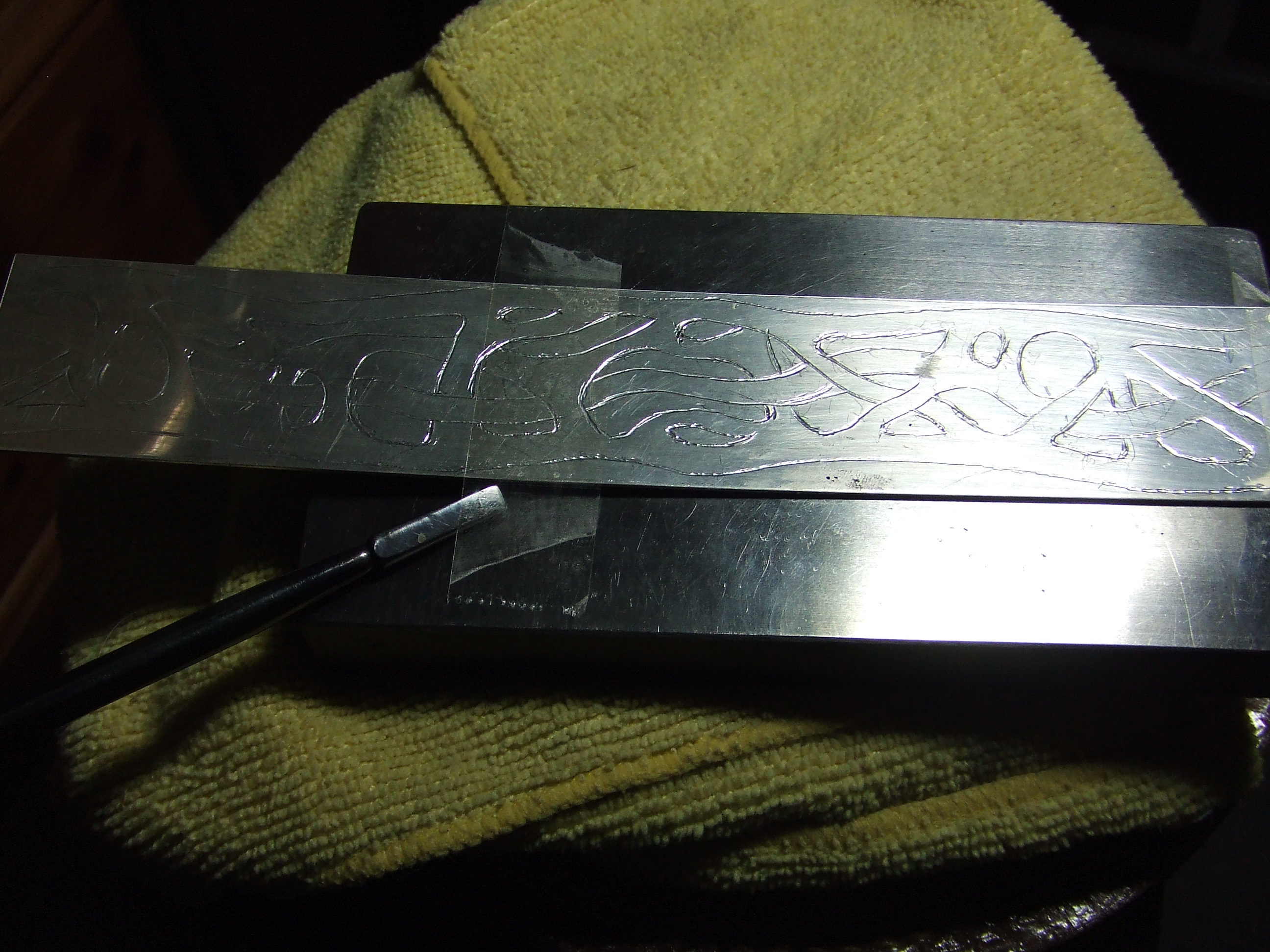
The two lining tools used to complete this sheet. The ‘skeleton’ of the pattern can be seen here. See text for explination

DSCF1309

Lining under progress, this was done with two sizes of lining tool. I hindsight I should have used curved liners, I would have been easier. I will introduce you to these in a later post.

DSCF1310

Lining completed before rounding on a mandrel to solder together, making the closed form. Not shown here id the ‘ghost’ impression of the lining process that is visible from the reverse. This is vital for the repousse stage as it shows the boundaries to keep within.

I introduce here the lining tool and the processes I use to transfer designs to sheet silver, copper or whatever metal takes your fancy.

You can use gouache paint, as here, or draw directly onto the silver. I have has some great results using Rotring isograph drafting pens on silver. When the ink dries it is quite durable and the lines are super accurate and regular.

The template I drew was for the heart on your sleeve bracelet, modified after the copper prototype. I made the strip actual size, joining the ends to ensure that the ends met so that after lining I would be able to solder together the ends safe in the knowledge that the design would work.

I used a scalpel to cut out the low spots, this was to help me to better see the result of the design, making alterations easy at this paper stage before committing to the stirling silver sheet. Once happy with the look and flow of the design, I taped the paper to the silver and drew around it with pencil to transfer the lines onto the dry white gouache layer ready for the lining tool to impress the line into the sheet. The paint was only applied to give the pencil something better to key to and make the lines more visible.

Shown here are only two types of lining tool, I will post again to give examples of more types. For now, so as not to go into too much tool detail this will serve to give a broad understanding that will make the understanding of these tools easier in upcoming posts.

I used a polished steel plate, taped the silver sheet to it to stop it moving around. You do not have to do this, less intricate designs and larger pieces may not require you to need to do this. I found it helped with this design.

I will go into more detail later about holding the tool, and other aspects of this early stage  next time.

Welcome to this silversmithing and jewellery blog

statment  

Thank you for visiting, with luck you may find something of use here to enable you to advance in our chosen craft. Inspired to start a blog by looking at others, only to find that few in this field either exist, or keep up to date. For sure, many more will contribute as time goes, hopefully this is a place that, perhaps, you may still reference back to from time to time.

The attached PDF is to introduce myself, showing what I display with some of my work to inform potential customers browsing in a shop or gallery.

I made a commitment to keep this blog going for a year to see if I could contribute something of interest, or perhaps some examples of work missing that people, such as yourself, may like to see more of, even ask questions perhaps.

Over the coming weeks and months, some personal content as well as more craft specific topics will be presented. It is a hope that you will feel more inclined to interact if you know a little more about me and my approaches to solving the many and varied challenges presented when attempting to ‘communicate’ in an unfamiliar, three dimensional craft.

My outlook mirrors my approach to making. I started out on this path as an escape from everyday, negative, workplace experiences taking the decision that I wanted to be a craftsman first and foremost, hoping the making money equation would work itself out afterwards. This is not a very smart approach for a person who wishes to make a living in a short time. Practice takes away earning potential, a fair profit can be made making very simple things, what is it that drives you? I have no desire to appeal to everyone. A low boredom threshold and a fear of being a ‘success’ making things that become tedious, too profitable to stop making due to high demand and very low margins, making volume necessary to the exclusion of new ideas, directions and adventures. The methods I choose, and time it takes to create makes many of my pieces unsuitable for mass production, they are as unique as you are as a result. I may have to swallow the reality of the market and compromise, wait and see eh.

Later on I will introduce you to Chasing and Repousse, some forging, and a particular favourite, sinking and hand raising of vessels. I will give examples of raising, making and finishing stakes, as well as tool making to enable you to realise your own beautiful results.

For the ones among you who are poor at communicating your ideas on paper, we are kindred spirits. I am constantly practicing my art skills, when I post a picture you will understand that I am no natural talant. However I am continually striving to improve. I mention it here as it has been a real hinderance in an educational setting. The work I have made is in spite of not being a natural, so now you can go for it as well, safe in this example that you do not neccessarly need to be great with a pencil or brush to make good quality work in metal.

Please do not think this a celebration of ignorance, I have to work harder as a result and I am pushing harder to be better. I mention it here only to give some encouragement to someone who thinks they are handicapped and unnable have one without the other, please just go for it.

It is my belief that through a disciplined and structured approach to the craft, truly awesome results can and do happen. It is my sincere hope that you are able to experience something of the feelings I get when I have completed a piece that may have taken many hours, both in conception and completion to make. I still get such a thrill as I turn the completed work in my hand all the while giggling to myself thinking, I did that. Truly a fantastic, life enhancing feeling that is yours for the taking if you spend the time realising your ideas in glorious three dimensional creations.

You know you want to, you can and will, just apply yourself. I look forward to sharing with you.

Very best wishes.

Stuie